

You found a buyer. You have a closing date in mind. There’s just one problem. Someone is still living in the house, and they won’t leave.
Dealing with unwanted occupants can be tedious. They can be the tenant who overstayed their welcome, that cousin who moved in for a couple of weeks and never left, or that person who broke into your house and made it their home. All of these can delay your home’s sale, and that’s where the problem lies… time.
You want to quickly deal with an unauthorized occupant and get your house sold. But you have to be careful about how you go about it. What you do (or don’t do) can affect your buyer and your window of sale. You can even get a lawsuit in the process. This guide can show you the legal ways to remove an authorized occupant and sell your house in Delaware.
First, Figure Out Who You’re Actually Dealing With

Not every person who won’t leave is the same in the eyes of the law. Before you do anything, identify the type of occupant. Your legal path depends on it.
Holdover Tenants
In Delaware, there are some legal protections for holdover tenants. A holdover tenant is someone who signed a lease that has now expired but has not vacated the property. You cannot simply throw them out. You still have to formally evict them.
Squatters
An individual who is squatting on a property never signed a lease agreement, nor have they ever paid rent. Squatters move into empty or unoccupied property and make it their residence. Squatters have no tenant rights. However, once a squatter makes a property their residence, Delaware law requires property owners to evict squatters through legal proceedings.
Trespassers
A trespasser is someone with no claim to live there at all. Think of a person who just broke in days ago. If police confirm there’s no residency claim, officers can often remove a trespasser right away. This is the fastest category to resolve.
Family Members or Guests Who Overstayed
This one gets messy. A guest who stays long-term can sometimes gain occupant status over time. If they’ve received mail there, kept belongings, or stayed for weeks, courts may treat them like a tenant. That means you may need to go through eviction, even without a written lease.
Why an Unauthorized Occupant Stalls Your Delaware Home Sale

Most traditional buyers want a vacant home at closing. They plan to move in. A person still living inside kills that plan fast.
Occupied properties deter lenders. Banks are unwilling to support a mortgage on a property with an occupancy dispute. Showings are next to impossible when an individual is non-cooperative. Title companies will likely identify the occupancy issue before closing.
Simplicity is best. An unauthorized occupant will reduce your potential buyers and increase the time to sell your property. This is why addressing the occupancy issue immediately will ensure a smooth sale.
What You Absolutely Cannot Do in Delaware
This is the part that trips up frustrated owners. When someone won’t leave, the temptation is to take matters into your own hands. Don’t.
Delaware bans “self-help” eviction. Changing locks is not an option. Shutting off water, power, or heat is illegal. You cannot remove any items from the premises or physically eject someone. You cannot intimidate or coerce someone into leaving.
All of the mentioned actions are illegal. Doing any of them opens you up to monetary penalties and civil lawsuits. In addition, it can give the occupant an advantage and can stall the sale for an even longer period. In Delaware, only the courts and the police can remove an occupant.
To check what the current applicable rules are, it is best to check the landlord-tenant laws yourself. You can find them in Delaware Code, Title 25. When money is to be lost and property is to be sold, the laws are worth your attention.
The Legal Path: How to Remove an Occupant in Delaware
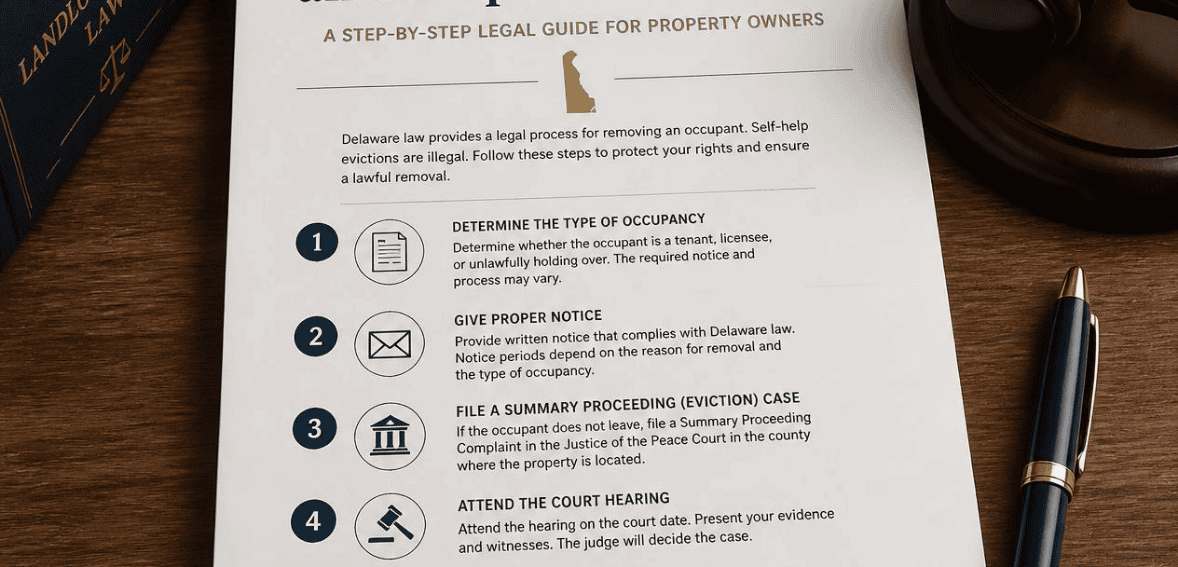
If the person won’t leave voluntarily, the formal eviction process is your reliable route. Here’s how it generally works in Delaware.
Serve the Correct Written Notice
Everything starts with proper written notice. The type depends on the situation.
A 5-day notice to pay rent or quit is standard for landlords dealing with unpaid rent. Lease agreement violations resulting in an unauthorized occupant living in the unit would require landlords to give a 7-day notice to comply or vacate. The notice requirements for serious criminal activities on the property are more restrictive. If you are terminating a month-to-month agreement to sell, a 60-day notice is generally required in Delaware.
Making sure the notice is correct is critical. The most common reason an eviction is delayed or thrown out is a notice that was not correctly served.
File a Summary Possession Action
Summary possession cases are filed when the rent is overdue and the deadline for payment has passed. This type of case is heard by a Justice of the Peace in the county where the property is located. The Petitioner will have to bring evidence to the hearing, which may include the lease, payment history, photographs, and the notice served.
Official Delaware Justice of the Peace Court documentation can provide more detailed information on how to file and what to expect at the hearing. This court addresses the majority of landlord and tenant disputes in the state.
Attend the Hearing and Get a Writ of Possession
The hearing follows next. If the occupant does not show up, by default the court rules in your favor. If both parties attend, the judge listens to the evidence and makes a decision.
If you are awarded the case, the court then prepares the Writ of Possession. The Writ of Possession then gives the occupant between 10 and 24 days to leave the premises. Once the time is up, if the occupant has not left the premises, it is the duty of the Sheriff of the County to remove the occupant. It is not your job to do the removal.
Cash for Keys: A Faster Alternative to Eviction
Court cases take time. Sometimes weeks. Sometimes months. When you have a buyer waiting, that delay hurts.
“Cash for keys” accurately describes the transaction: you pay the occupant to pack up and vacate the property by the date specified in the agreement, which you must write up.
It would appear odd to pay a person to leave a property, but you must account for the money, as well as loss of time while the property sale is on hold, and the cost of legal representation. Cash for keys agreements resolve the situation much quicker and cheaper than a drawn-out court case. No money up front. No money until they leave.
Can You Sell the House Before They Leave?
Here’s some information that a lot of property owners don’t know. You can sometimes still sell your property with someone living in it. Valid leases are not canceled when the property is put up for sale. The right buyer won’t be deterred by a house that’s occupied.
Normally, buyers won’t buy the property if it’s occupied, but there are investors and buyers who specialize in buying occupied properties. They take the opportunity and the property as it is. They solve the occupancy issue and are quick to close.
Cash Home Buyers
Cash home buyers are companies or investors that purchase properties directly, often in any condition. Many will buy a house with a tenant, holdover occupant, or even a squatter still inside.
This route takes care of the occupancy issue in one shot. There is no need for showings. There is no need for repairs. You commonly skip the long evictions as the buyer takes on that burden. The process can take only days, as opposed to months. The downside is the price will most likely be less than what you would receive for a fully vacant property on the open market. For a lot of sellers dealing with an unauthorized occupant in Delaware, that is a price they are willing to pay for the speed and the guarantee.
If you are going to take this route, make sure to do some serious vetting of this buyer. Make sure they can and will put real money on the contract. Make sure the buyer agrees to take on the occupant and that this is stated clearly in the contract. You do not want this responsibility coming back to you.
Smart Tips to Protect Your Sale and Your Timeline
Avoiding any interruptions to your business operations from tenants can be easily achieved by working out a system to eliminate potential minor annoyances quickly. Therefore, it is vital that you keep records pertaining to your interaction with your tenants from the very beginning. You should keep copies of the tenancy agreements, any required notices, all electronic and telephonic correspondence, and records of rent payments. Additionally, keep records of the property in digital format.
It’s often said that “the early bird gets the worm.” This is especially true in this case because the longer you delay in acting to evict a tenant, the harder it becomes. In the case of troublesome squatters, it is possible that after many years they may attempt to legally claim that they have a right to remain in the property, which will rarely succeed if you have acted as a property owner.
When selling your property, always be transparent with potential buyers. Ensure you make the buyer aware of the occupancy problem before any sale transaction. No buyer appreciates surprises at a deal completion. Therefore, if you are aware that the occupancy problem is complicated, it is best to consult with a Delaware real estate attorney for legal advice before it gets any more complicated.
Conclusion
Someone refusing to leave feels like a dead end. It isn’t. It’s a solvable problem with a clear playbook.
Start by identifying the occupant. Then follow Delaware’s legal process, or negotiate a cash-for-keys exit, or sell the property as-is to a buyer who takes on the occupancy. Never try to force anyone out yourself. That single mistake causes more delays than the occupant ever could.
The key is to act early, stay calm, and pick the path that fits your timeline. Whether you fight the eviction, buy your way to a clean exit, or sell to a cash buyer, you have a way forward. Your sale isn’t stuck. It just needs the right move.
Frequently Asked Questions
Can I sell my house in Delaware if someone is still living in it?
Yes. You can legally sell a property even with an occupant inside. Selling the home does not cancel a valid lease on its own. Traditional buyers often prefer vacant homes, but investors and cash home buyers regularly purchase occupied properties. They typically take on the occupancy issue themselves and close quickly.
How long does it take to remove an unauthorized occupant in Delaware?
It varies. A trespasser with no residency claim can sometimes be removed quickly by police. A holdover tenant or squatter usually requires the full court process. That means serving notice, filing in the Justice of the Peace Court, attending a hearing, and waiting for the Writ of Possession. From start to finish, this can take several weeks to a few months, depending on the case and the court’s schedule.
Is cash for keys legal in Delaware?
Yes. Cash for keys is a legal, voluntary agreement. You offer the occupant money to move out by a set date, leaving the home clean and empty. It’s often faster and cheaper than a formal eviction. Always put the terms in writing and pay only after the person has fully moved out.
What happens if I change the locks or shut off utilities to force them out?
That’s illegal in Delaware. Changing locks, cutting off water or power, or removing belongings counts as a self-help eviction. It can lead to penalties, lawsuits, and even longer delays. Only a court order and the Sheriff can legally remove someone. Always use the formal process instead.