
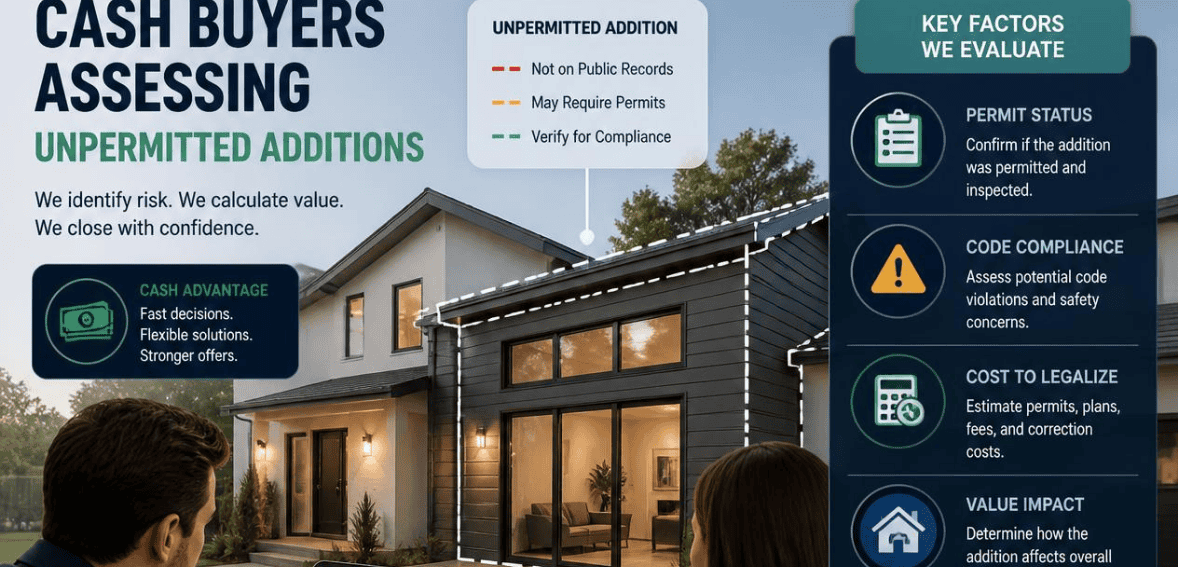
You pull out the old paperwork to sell your house. Then it hits you. That cozy sunroom off the kitchen, or the extra bedroom the last owner tacked on, was never permitted. Suddenly a simple sale feels complicated. If you are staring down an unpermitted addition house sale in Delaware, take a breath. This situation is far more common than most people think. And cash buyers deal with it every week.
The good news is that most buyers will still consider your property, even where a permit is missing for the addition. They will just need to account for the missing permit in their offer. Understanding the math behind the permit puts you in control. Below, we explain how we think cash buyers evaluate unpermitted additions, what factors they consider, and where we think Delaware’s disclosure law applies.
What Counts as an Unpermitted Addition?
An unpermitted addition is any expansion or major change to a home built without the required approvals from the local building authority. Permits exist to confirm that work meets safety codes and zoning rules. When someone skips that step, even skilled work is considered noncompliant on paper.
There are probably as many examples of this as there are homes. A garage turned family room. A basement with added bedrooms. A porch that’s been enclosed for year-round living. There are also added bathrooms, horizontal extensions, and porches converted into living space. Most of this is the result of a previous owner’s DIY project, and although the spaces probably look nice and function well, they are not legally recognized. A buyer has to discount this.
Why Cash Buyers Fit an Unpermitted Addition House Sale in Delaware
Financing is where most unpermitted deals stall. Traditional lenders lean hard on the appraisal. And appraisers will not count unpermitted square footage toward value. So that extra 300-square-foot room might feel like real value to you, yet it adds nothing to the number the bank uses.
FHA and VA loans have even stricter requirements. Their appraisers usually flag unpermitted work and require it to be resolved before closing. Some potential buyers taking the path of least resistance can overcome this hurdle by means of larger down payments. However, this is not a desirable or efficient means of addressing the problem.
Cash buyers don’t have to worry about any of this. The absence of a lender means the absence of an appraisal contingency. Cash buyers decide the value of a property without a bank’s assistance. This is a cash buyer’s greatest advantage for a house with an unpermitted addition in Delaware. This helps a seller to avoid the additional costs of repairs or unpermitted work done prior to selling. It also means the seller will not face a delayed closing while the buyer procures financing.
How Cash Buyers Put a Number on Your Home

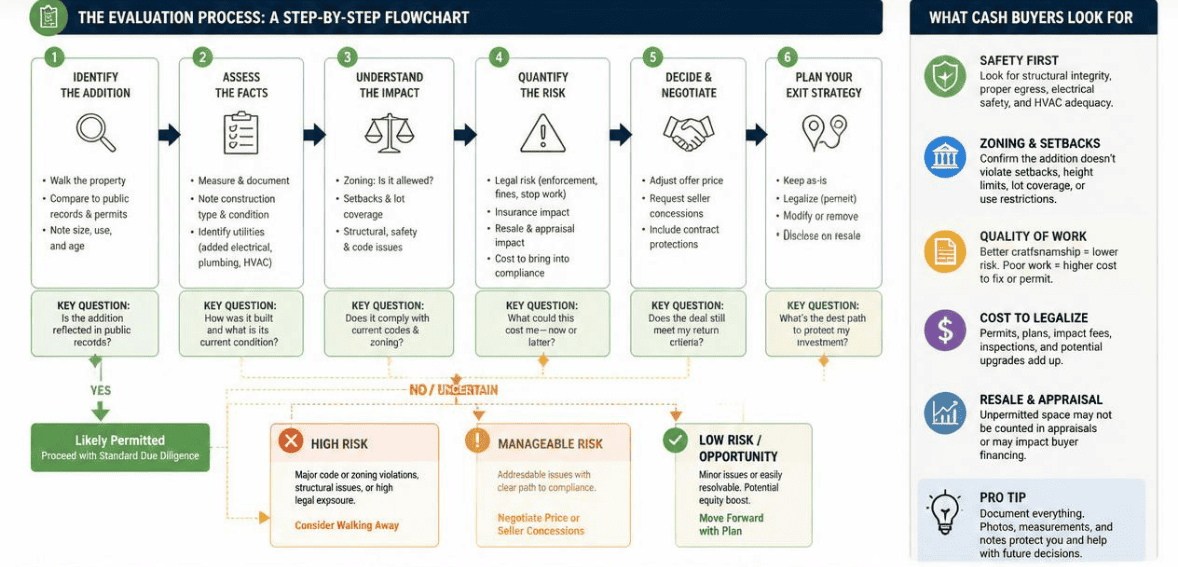
Cash buyers are not guessing. They run a fairly consistent formula, and knowing it helps you read any offer that lands in your inbox.
The After-Repair Value Starting Point
Every serious offer starts with the After-Repair Value, or ARV. This is what your home would sell for, fully renovated and move-in ready, based on recent comparable sales nearby. Investors look at similar homes in size, age, and style that sold in the last several months, usually within a mile. ARV is the ceiling. Everything else works backward from it.
Most buyers begin with some version of the 70% rule. The offer is 70% of the after-repair value (ARV) minus the cost of repairs. If the ARV of the subject property is $300,000, and it requires $30,000 of repairs, the offer will be about $180,000. There is a range, since this is only an estimate. Clever Real Estate surveyed over 700 investors, and the median offer was around 67.5% of ARV. There are examples of homes in excellent condition in competitive markets being offered nearly 80% of ARV.
Subtracting the Cost of the Unpermitted Work
Here is where the addition matters. The buyer estimates what it will take to make the space legitimate or safe. That figure gets folded into repair costs. Then they layer in holding costs, which cover taxes, insurance, and utilities during the project, plus their target profit margin. A bigger question mark around the addition means a larger discount. A clean, well-built addition that is easy to legalize means a smaller one.
What Cash Buyers Look For in an Unpermitted Addition
Not every unpermitted addition drags an offer down the same amount. Buyers read a few signals closely, and these often decide whether they get aggressive or cautious with their number.
Can It Be Legalized After the Fact?
The largest factor is whether the addition can be permitted retroactively. If the completed work complies with the most up-to-date version of the building code, a buyer can typically apply for the permits after the sale. They are also able to remove the liability and potentially realize value from the work. This potential value makes buyers more willing to increase their purchase offer. If the work violates setback rules or zoning regulations, or the work would need to be demolished and completely rebuilt, the value discount increases. Legalizing work can sometimes mean removing wallboard so an inspector can check the electrical and plumbing. Buyers factor the inconvenience of inspections into their purchase offer.
Is the Work Safe and Structurally Sound?
Quality drives everything else. Buyers care most about the systems hidden from view. Structural framing, the roofline tie-in, electrical loads, and plumbing runs get the closest attention. A room addition with proper footings and clean wiring reads very differently than a garage conversion with a space heater and an extension cord. If a home inspection later confirms the work looks solid, the buyer’s projected costs drop. If the addition raises safety red flags, expect a steeper cut or a request to price it as a near-teardown of that section.
The Role of Disclosure in a Delaware Sale

The law in Delaware requires you to disclose issues that you know about. Chapter 25, Title 6 of the Delaware Code requires all residential property sellers to disclose all known material defects in writing prior to the property being offered for sale. This must be done on the Seller’s Disclosure of Real Property Condition Report, which is a form that the Delaware Real Estate Commission has approved. This disclosure must be updated if there are any changes to the material defects before the final settlement.
The Seller’s Disclosure of Real Property Condition Report form is a series of questions. There are questions regarding violations of laws relating to the property at the local, state, or federal level. There are also questions regarding orders from a department to make repairs or corrections. There are also questions regarding zoning. The unpermitted addition goes into all three. Legally, disclosing the addition is the right thing to do. It is also smart to disclose it, since building trust with the buyer reduces the chance of them walking away or filing a claim. The Seller’s Disclosure of Real Property Condition Report can be reviewed for further direction on reporting.
Title, Records, and the Paper Trail
Cash buyers not only investigate their side of the transaction, but they study the county side as well. During their review, they will look at the tax assessment and the permitting history to see if what is represented matches what is seen in the field. A home listed as a 3-bedroom that clearly has four bedrooms definitely raises a flag. This is usually the first sign that an unpermitted addition has taken place.
Even with a potentially problematic paper trail, cash sales usually proceed. However, the buyer will check assessed square footage, unclosed permits, and open county notices. These usually do not impact the title. Still, a cash buyer has mentally priced the time it takes to fix these issues into the closing number. To keep closing costs down, have your paperwork ready: receipts, notes from contractors, or old blueprints.
Where to Get a Cash Offer
Once you understand the math, the practical step is collecting real offers so you can compare them.
HomeLight Simple Sale
A popular option is HomeLight’s Simple Sale. It connects you directly with a network of investor cash buyers that buy properties as-is (even with repairs or unpermitted work). Sellers can submit a request for an all-cash offer and avoid having to do repairs or schedule showings. HomeLight claims sellers can close in as little as a week! HomeLight also has a guide for selling a house with unpermitted work if you want to dig deeper into how that works. Just like with any other offer, treat this as your first offer and request a few more before making any decisions. Legitimate cash buyers will give you time and not pressure you.
Conclusion
An unpermitted addition feels like a wall when you first discover it. In reality, it is just a variable in a formula that cash buyers solve all the time. They start with what your home is worth fully fixed, subtract the cost of making the addition safe or legal, add their margin, and hand you a number. Your job is to understand that math, disclose honestly under Delaware law, and shop your options.
Handle it this way and an unpermitted addition house sale in Delaware becomes a clear, fast transaction instead of a headache. Gather your paperwork, be upfront about the space, and let a few cash buyers compete for the deal. The right offer is usually closer than you expect.
Frequently Asked Questions
Do I have to disclose an unpermitted addition when selling my house in Delaware?
Yes. Delaware law requires you to disclose all known material defects on the Seller’s Disclosure of Real Property Condition Report before the home is offered for sale. An unpermitted addition falls under this. Failing to disclose it can expose you to legal claims after closing, even if a previous owner did the work.
Will an unpermitted addition lower my cash offer?
Usually, but not always by much. The discount depends on whether the work can be legalized, how well it was built, and whether it raises safety concerns. Homes with unpermitted work often sell for somewhat less than fully permitted comparables. A clean, code-ready addition trims that gap. A risky one widens it.
Can I sell as-is without getting a retroactive permit first?
Yes. Cash buyers routinely purchase homes as-is and take on the permitting process themselves. That is one of the main reasons sellers with unpermitted work choose a cash buyer over a financed one, since lenders often demand the work be resolved before closing.
How do cash buyers calculate their offer on a home with an unpermitted addition?
Most use the ARV formula. They estimate the After-Repair Value from local comparable sales, multiply it by roughly 70%, then subtract repair costs, including the cost to make the addition safe or permitted. Holding costs and profit margin come out of that too, which produces the final cash figure.